
Focus is the foundation everything else is built on. A new affiliate publisher rarely has the resources to become authoritative across an entire industry. Trying to sell everything to everyone means you sell nothing to no one — a crowded, generic site earns neither the trust of readers nor the ranking favour of search engines, both of which reward specificity. A smaller, clearer market gives you a better chance of understanding the audience, producing genuinely useful content and building a recognisable position.
The niche sweet spot
The strongest starting niches usually sit at the intersection of audience understanding, demand and monetisation. You do not need to be passionate about the subject, but you do need enough curiosity to keep learning and enough commercial relevance that useful recommendations exist.
- Knowledge or willingness to learn: Can you become meaningfully useful to this audience, or are you willing to become genuinely expert in it over time?
- Demand: Do people repeatedly search for information, comparisons, tutorials or solutions? Tools such as Google Trends, Ahrefs, or even Amazon’s bestseller lists can help confirm that people are already spending money here.
- Commercial intent: Are there products or services that solve the problems you cover, with enough affiliate programmes, price points and commission structures available that a single visitor can realistically earn you money?
- Content depth: Can you create dozens of genuinely different pieces without repeating yourself?
- Audience clarity: Can you describe the target reader in one sentence?
- Competitive opening: Can you add something better, more specific, more current or more practical than existing content?
A simple niche scoring framework
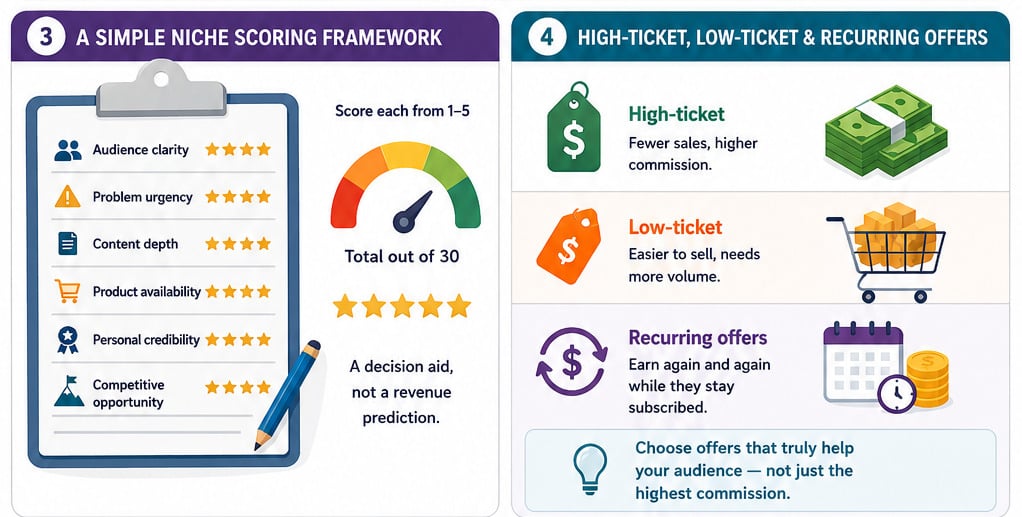
Instead of asking ‘Is this niche profitable?’, score each candidate from 1–5 against six questions: audience clarity, problem urgency, content depth, product availability, personal credibility and competitive opportunity. The total is only a decision aid; it is not a prediction of revenue.
| Question | What to look for |
| Who is the reader? | A recognisable person with a specific situation. |
| What problem are they solving? | A problem that causes time, money, uncertainty or frustration. |
| What do they buy? | Products, software, services, subscriptions, equipment or education. |
| Can you publish deeply? | At least 50–100 distinct useful topics over time. |
| Can you demonstrate expertise? | Testing, experience, original research, interviews or strong sourcing. |
| Is there room to differentiate? | A specific audience, use case, methodology, geography or format. |
High-ticket, low-ticket and recurring offers
A high-ticket offer — software, courses, or luxury and specialty gear paying $100 or more per sale — can produce a larger commission per conversion, but usually needs far less traffic to hit a given income goal, since each sale requires more trust-building content such as comparisons, case studies and detailed reviews.
Low-ticket products, such as everyday consumer goods sold through Amazon and similar catalogues, convert more easily because the buying decision is small, but the economics require volume: consistent traffic and a wide catalogue of products to recommend.
Recurring software subscriptions deserve special attention: one referral may generate multiple commission events for as long as the customer stays subscribed, making it one of the purest forms of passive income in this space.
Do not choose a niche solely because one programme advertises a large commission. The better question is whether the product is a natural extension of the audience’s problem. A £20 commission on a product that readers love can be more valuable over time than a £200 commission attached to a poor-fit offer.
Audience pain points
The best niches solve specific, urgent problems rather than vague aspirations. Instead of ‘fitness’, consider ‘strength training for busy professionals over 40’. Instead of ‘technology’, consider ‘home-office technology for remote developers’. Instead of ‘finance’, consider ‘cash-flow tools for UK freelancers’. The narrower framing does not prevent expansion later; it gives the business a place to start, and readers immediately recognise themselves in the content.
Validate before you build
- Search for the ten most obvious questions your audience would ask.
- Inspect the current results. Look for outdated, shallow or poorly demonstrated answers — but remember that competition is not automatically a problem; thin competition is an opening.
- Identify at least 3–5 plausible merchants or affiliate programmes, spanning different price points so you are not dependent on a single one.
- List buyer-intent topics such as ‘best’, ‘review’, ‘comparison’, ‘vs’, ‘alternative’, ‘pricing’ and ‘how to choose’ — these searchers are closest to making a purchase.
- Check whether you can produce original evidence: screenshots, experiments, testing notes, interviews, calculators or datasets.
- Picture writing 100 articles on this topic. If the idea feels exhausting after ten, the niche is too narrow or the wrong fit for you personally.
| Pro tip
Spend an afternoon in forums like Reddit or Quora, or in the comment sections of top-ranking articles within your target niche, and note every question people repeat. Those recurring questions are a free, validated list of your first twenty pieces of content — you already know people are searching for the answers. |
Leave a Reply