
How to Create High-Converting Affiliate Content That Sells
To Download the Full, Free 31 Page Ebook, Affiliate Marketing Passive Income: Click Here
Nobody opens a browser hoping to read an advert. People go online to fix a problem, learn something or be entertained. That one fact explains why so much affiliate content falls flat.
Content that opens with a sales pitch gets ignored or distrusted. Content that helps first, and mentions a product as the natural next step, is what converts. This guide shows you how to build the second kind.
Value first, pitch second
Think about the last recommendation you acted on. It probably came from someone who had already helped you, not someone who opened with a discount code.
Your readers work the same way. If a page simply repeats the merchant’s sales copy, they have no reason to trust it and no reason to stay. If it solves their problem, the product you recommend stops feeling like an advert and starts feeling like advice.
So before you write a word, ask what the reader came for. Deliver that. Then make the recommendation. That order matters more than any headline formula or button colour.
Climb the content ladder
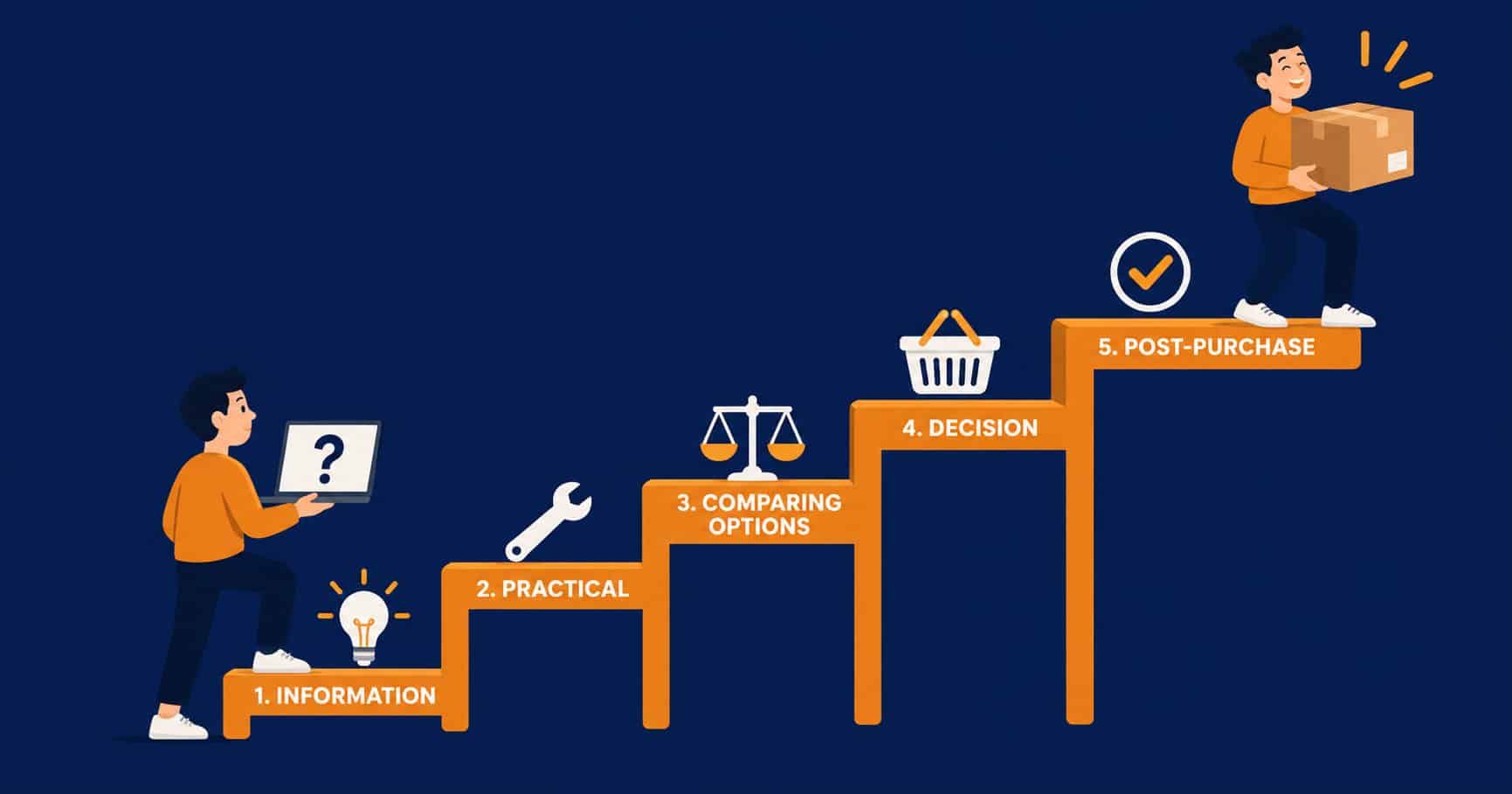
Readers arrive at different stages, and a durable content portfolio meets them at each one. Picture a ladder with five rungs:
- Informational: explains a problem or concept.
- Practical: shows the reader how to do something.
- Commercial investigation: helps them compare options.
- Transactional: supports a decision they are already close to making.
- Post-purchase: helps customers set up, use or improve what they bought.
The common mistake is to publish only “best X” articles. Those pages can be commercially valuable, but they are also the easiest to make generic. Surround them with educational and practical content and two things happen. Your site gains real depth, and you create internal links that carry readers from learning to choosing.
A reader who lands on an informational piece today may not be ready to buy for weeks. If your site has the next rung waiting, they climb it with you instead of with a competitor.
Five formats worth building
You do not need every format on day one, but each of these earns its place.
Original reviews and comparisons. Honest, in-depth write-ups covering what you tested, who it suits, what it does well, where it falls short and what you would change. These attract high-intent buyers who are close to a decision.
How-to guides. Teach a process and let products appear as tools. “How to Start a Podcast” can link naturally to specific hosting and microphone recommendations without turning the tutorial into an advertisement.
Resource pages. A “Tools I Use” page listing every product or piece of software you genuinely rely on. Keep it honest: if you have stopped using something, take it off the list.
Buyer’s guides. Explain which features matter and which are mostly marketing. These serve readers who know they want to buy something but have not decided exactly what.
Case studies and personal experiments. Document a real workflow, experiment or before-and-after process, with its limitations stated clearly. This builds a level of trust that generic reviews cannot match.
A review structure readers trust
A good review answers the reader’s questions in the order they ask them. Use this nine-part structure:
- Who the product is for.
- The problem it solves.
- How you tested or evaluated it.
- Its best features, in practical terms.
- Limitations and trade-offs.
- Alternatives.
- Pricing and ongoing costs, if relevant.
- Who should skip it.
- A clear disclosure and next step.
Notice how much of that list is about limits: trade-offs, alternatives, who should skip it. That is deliberate. Being honest about a product’s downsides makes a review more persuasive, not less, because it signals that the recommendation can be trusted.
Use evidence, not adjectives
Adjectives are cheap, and readers know it. “Amazing”, “easy” and “best” appear on every sales page, so they have stopped meaning anything. Swap each one for something a reader can check:
- Instead of “amazing battery life”, give a measurable test or a precise observation.
- Instead of “easy to use”, list the specific steps a task requires.
- Instead of “best for everyone”, define the use case.
A detail such as “it took me four minutes to set up” is far more credible than any amount of marketing copy. Specificity does double duty: it makes your content believable and gives readers information they can actually use. Write as if the reader will check your claim, because the careful ones will.
Place links at decision points
Where you put a link matters as much as what it points to. Cramming links into the first paragraph asks readers to buy before you have helped them.
Place links where a decision naturally happens instead: after you have explained who the product suits, beside a comparison, or at the step in a tutorial where the tool is needed. By then the click is the reader’s idea, not yours.
Build an update system
Publishing is not the finish line. Products change, links break, prices move and new competitors appear. A page that was accurate last year can quietly mislead readers today.
Every affiliate site needs an update calendar. Review your highest-value pages regularly and check:
- Links and merchant availability
- Pricing
- Screenshots and specifications
- Claims
- Search intent
- Whether the recommendation still makes sense
That last check is the hard one. If a product no longer deserves your recommendation, change the recommendation, even if it reduces your commission. Long-term trust is worth more than one short-term conversion.
Help first, and the sales follow
High-converting content is not a trick of wording. It is the result of helping readers at every stage, proving your claims with specifics, admitting what a product cannot do and keeping your pages accurate over time. None of this is quick, but all of it compounds. Each helpful page makes the next recommendation easier to believe.
Start small. Pick your highest-traffic page this week and run it through the nine-part review structure. Replace three adjectives with evidence. Move one link to a real decision point. Then put a date in your calendar to check it again.
#AffiliateMarketing #ContentMarketing #AffiliateContent #ContentStrategy #SEO #Blogging #ProductReviews #Copywriting #DigitalMarketing #ConversionOptimization
Leave a Reply