
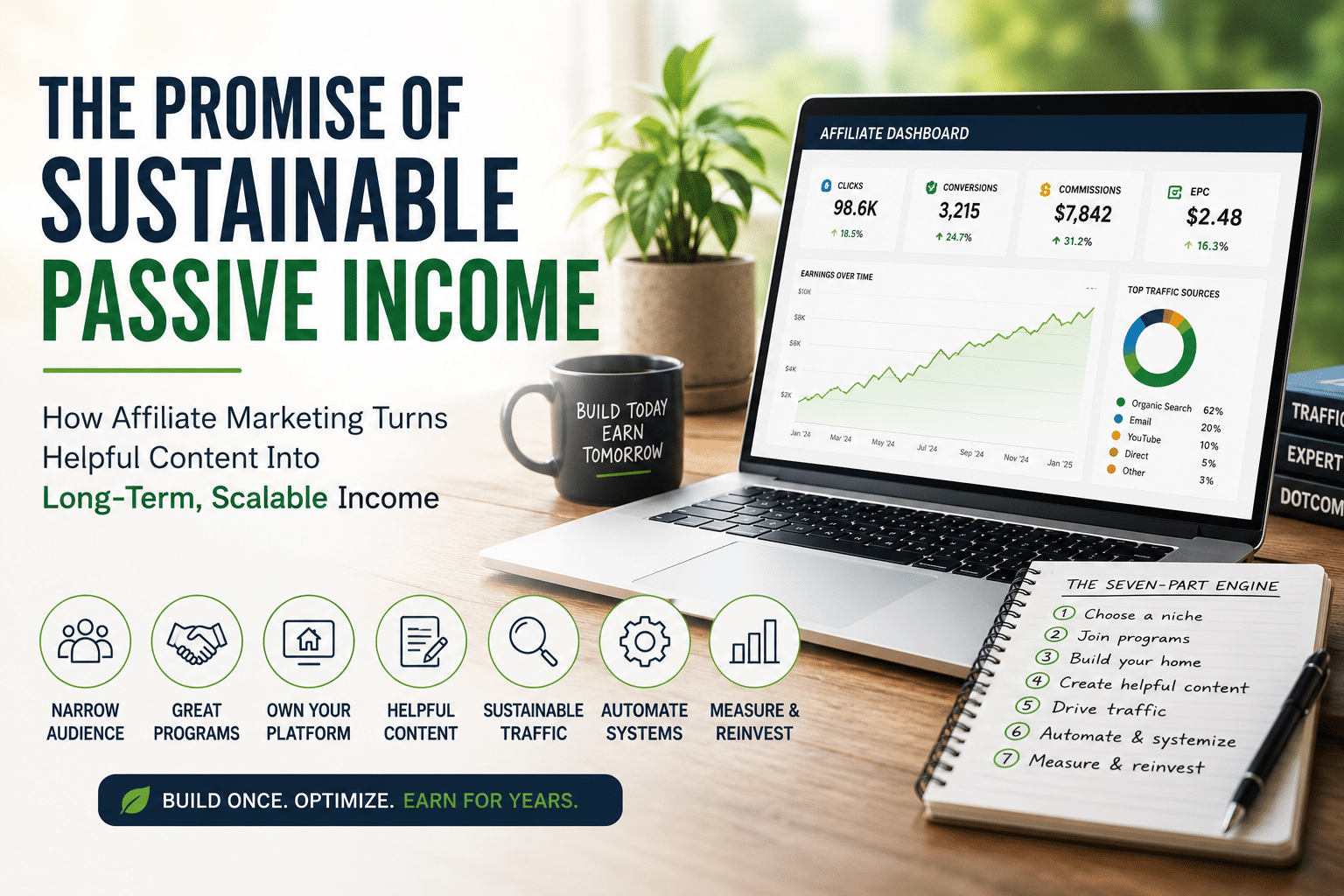
The Promise of Sustainable Passive Income
Imagine waking up to a notification that a visitor bought a product through an article you published months ago, or to sales that happened while you were asleep. That sale did not require you to manufacture the product, hold inventory, process a payment, or personally handle the customer’s support request. That is the attraction of affiliate marketing: you build trust with an audience and point that audience toward solutions that genuinely help them, earning a referral commission when they choose a product or service.
But there is an important distinction between an affiliate business and a passive-income fantasy. The passive part comes later. First you build the asset: a focused website or media channel, a library of useful content, an email audience where appropriate, trusted merchant relationships, and systems that make repetitive work easier.
What eventually transforms a simple recommendation habit into a sustainable, scalable stream of income is the combination of three ingredients: evergreen content that stays useful for years, automated funnels that nurture and convert visitors without your daily involvement, and compounding traffic sources — such as search engines and email lists — that keep growing instead of resetting to zero every day.
The underlying market is substantial. The Performance Marketing Association’s 2025 U.S. industry study reported that affiliate marketing spending increased from $9.1 billion in 2021 to $13.62 billion in 2024, a 49.8% increase. The study estimated that affiliate marketing generated $113 billion in U.S. e-commerce sales in 2024 and represented 9.4% of U.S. e-commerce sales. These are U.S.-specific industry estimates, not a guarantee of what an individual publisher can earn.
A separate 2026 industry roundup from Shopify reported a global affiliate-marketing market estimate of $18.4 billion for 2025 and cited an eMarketer forecast of $12.42 billion in U.S. advertiser spending in 2025. Because these figures come from different methodologies and sources, treat them as indicators of market scale rather than perfectly comparable measurements.
What these numbers really tell you: affiliate marketing is an established commercial channel. They do not tell you that a new website will become profitable quickly, or that a particular niche will work.
| Set expectations early
Passive income is never truly “no effort.” It is front-loaded effort: weeks or months of building, followed by a long tail where the asset keeps paying you back. Anyone who promises overnight results without that build phase is selling a fantasy, not a business. |
What ‘passive’ should mean
A more useful definition is low-marginal-effort income: you do substantial work upfront, then create systems and assets that can generate additional results without a matching increase in daily labour. A ranking article can serve thousands of readers. A tutorial video can be discovered months after publication. An automated welcome sequence can educate every new subscriber. A comparison table can help hundreds of people make the same decision.
The work does not disappear. It changes shape. Instead of doing everything manually, you monitor, update, test and improve a system.
The seven-part engine
- Choose a narrow audience and a commercially useful problem.
- Join affiliate programmes whose products genuinely fit that problem.
- Build a digital home you can control and maintain.
- Publish original content that helps people understand, compare and use solutions.
- Acquire traffic from search, video, email, communities and other appropriate channels.
- Automate repetitive steps such as lead delivery, onboarding and reporting.
- Measure economics and reinvest in the content and channels that demonstrate traction.
Leave a Reply